


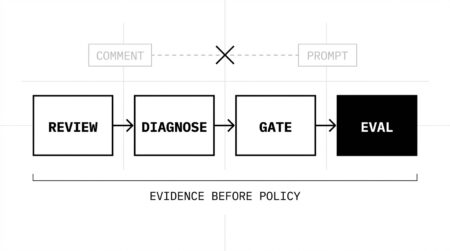
Learning from creative feedback without turning comments into policy
How to decide which corrections should change an AI workflow
TLDR: Directly appending reviewer comments to prompts turns ambiguous observations into conflicting policy rather than genuine learning. Instead, feedback must be treated as diagnostic evidence that is attributed to its root cause, gated by designated owners, and evaluated on held-out tasks before any durable workflow change is approved.
A reviewer rejects an AI-generated video and writes: “The product needs to appear in the opening scene.”
It sounds like useful feedback. It is also dangerously incomplete.
The comment might describe a requirement for this campaign. It might be a stable rule for this client. The rule might already exist, but the workflow failed to apply it. The product may have appeared, but the evaluator missed it. Or the comment may be one reviewer’s preference rather than a rule that should govern future work.
If the system immediately appends the sentence to a prompt, it has not learned. It has converted an ambiguous observation into policy.
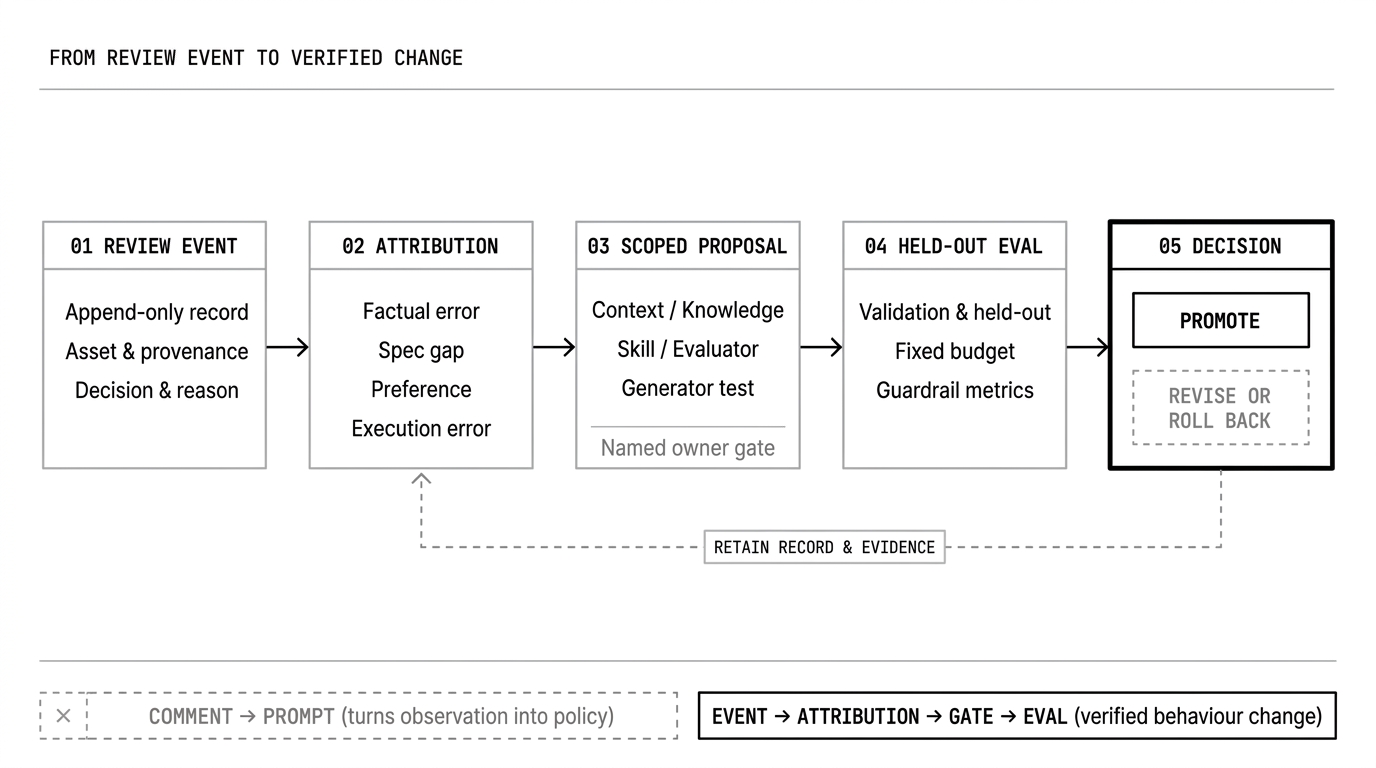
Useful learning requires a longer path:
review event
  -> attributed evidence
  -> scope and cause
  -> candidate intervention
  -> held-out evaluation
  -> promote, revise, or roll back
The difficult part is not collecting more comments. It is deciding what each comment is evidence about, who is allowed to act on it, and whether the proposed change makes future work better.
Feedback is an event, not an instruction
A review record should preserve what happened before interpreting it.
At minimum, an eligible review record needs the asset and run, the decision, the criterion being applied, the reviewer’s role, the relevant visual or temporal evidence, and the reason given. It should also retain the versions of the brief, knowledge, skill, evaluator, model and generation settings that produced the candidate, subject to client rights, access controls, redaction and deletion policy.
That provenance matters because the same comment can diagnose different failures.
If the brief never required an opening product shot, the issue may be an underspecified campaign decision. If the requirement existed in approved client knowledge but never reached the script, retrieval or context construction failed. If the script contained the requirement but the storyboard omitted it, the scene-planning skill failed. If the frame was correct and animation removed the product, the generator or motion controls failed. If the video was correct but the automated test rejected it, the evaluator failed.
The reviewer sees the final symptom. The system needs enough evidence to locate the cause.
This is why the original record should be append-only within its retention period. Later analysis can be wrong. A proposed fix can fail. The original event should remain available to authorised reviewers so the diagnosis can be challenged without reconstructing history from the current prompt.
Disagreement is part of the signal
Creative review is not a clean labelling task.
Two qualified reviewers can apply different interpretations of the brief. One may optimise for immediate product clarity; another may value curiosity before the reveal. A third may notice a gameplay error that neither of them saw. Flattening those judgements into a majority label removes information about the decision.
Research on human preference datasets illustrates the broader problem. Zhang and colleagues found diverging preferences in more than 30% of examples across two datasets. Most of the analysed disagreements reflected factors such as task underspecification, complexity, verbosity or response style rather than simple annotation mistakes.[1]
Those datasets concern language-model responses, not creative video. The percentages should not be transferred to Replai’s work. The relevant lesson is narrower: disagreement can expose a missing specification or a legitimate difference in preference. It should not automatically be discarded as noise.
For creative feedback, the system should distinguish at least four cases:
- A factual error. The reviewer lacked the current product rule, or applied the wrong version.
- A specification gap. The brief or rubric does not resolve the disputed case.
- A genuine preference difference. Several outputs are valid for different creative strategies or audiences.
- An execution error. The criterion is clear, but the workflow failed to satisfy it.
These cases need different actions. Correcting a factual error may update knowledge. A specification gap needs an owner to clarify the rule. A genuine preference difference may call for alternatives or audience segmentation rather than one global answer. An execution error may justify a skill, evaluator or generator change.
Agreement is useful evidence. It is not a substitute for deciding what kind of judgement is being made.
Approval is still a proxy
Even consistent feedback can reward the wrong behaviour.
A reviewer under time pressure may prefer the most polished candidate while missing a product error. A model judge may reward visual fluency over gameplay fidelity. An acceptance metric can favour safe, familiar concepts and gradually suppress useful novelty.
This is not hypothetical in preference learning. Anthropic found that human and preference-model judgements sometimes favoured responses that agreed with a user’s stated view over more truthful responses, and that optimising against the preference model could sacrifice truthfulness for agreement.[4]
Again, creative production has a different objective. But the mechanism transfers: optimisation amplifies whatever the feedback process rewards, including its shortcuts.
A feedback loop therefore needs guardrail dimensions that are not collapsed into one approval label. Depending on the decision, these may include product fidelity, brand compliance, technical generation quality, novelty, reviewer effort and cost per accepted output. A change that improves one dimension while damaging another is a trade-off, not an unqualified improvement.
Diagnose the decision before choosing the fix
The same symptom can justify different actions. The intervention should be the narrowest reversible change that addresses a demonstrated cause, not simply the cheapest change available.
| Evidence from the review | Diagnosis to test | Candidate action | Durable-change authority |
|---|---|---|---|
| The requirement exists only in this brief | Campaign scope | Correct the working context | Campaign owner |
| An approved client rule was missing or superseded | Knowledge scope or freshness | Update the scoped knowledge record | Knowledge owner |
| The rule was available but the procedure ignored it | Procedural failure | Propose a versioned skill change | Skill maintainer |
| The asset satisfied the rule but the judge rejected it | Evaluator failure or ambiguous rubric | Revise the rubric, examples, threshold or escalation policy | Evaluation owner |
| The failure persists after strong controls | Generator capability gap | Run a model, control or adaptation experiment | ML/product owner |
| Reviewers disagree about the desired result | Unresolved preference or specification gap | Preserve the disagreement and adjudicate or branch the objective | Named domain owner |
These are logical boundaries, not necessarily separate databases. CoALA makes a related distinction between episodic experience, semantic facts and procedural behaviour, with different operations for each.[3] The practical issue is governance: who may change a layer, at what scope, and on what evidence?
Attribution is often uncertain from one trace. Test competing explanations before authorising a durable change. Re-run the case with the correct knowledge forced into context. Swap the evaluator while keeping the asset fixed. Apply the proposed skill change without changing the model. Compare a new model under the same shot specification. These are small ablations, not perfect causal experiments, but they can prevent an expensive intervention from masking a simpler failure.
If attribution remains weak, the correct action is to collect more evidence or escalate the case—not to update shared behaviour with low confidence.
Separate a proposal from active behaviour
One correction can fix one case. Repeated, attributable evidence can justify a reusable change, but the proposal should remain separate from the active workflow until an authorised owner accepts it.
WikiSkill provides a useful research example: raw traces, accumulated knowledge and active skills are kept distinct, and candidate skill changes are gated by validation.[2] “A failed run is not yet a skill” examines that skill-evolution mechanism in detail. This post owns the preceding governance question: whether a review event is sufficiently scoped and attributed to justify proposing a change at all.
A feedback record should therefore answer:
- Which decision failed?
- What evidence localises the failure?
- How often has the same cause appeared?
- Under which clients, briefs, models or reviewers?
- What rule or procedure was active?
- Who owns the proposed change?
- What behaviour must the intervention preserve?
The proposal, its authorisation, its evaluation and its eventual status should be recorded separately from the original review event. This prevents a generated summary from silently becoming policy.
Test authorisation on work that did not propose it
A correction will usually improve the example that motivated it. That is weak evidence.
Before a durable change is released, use a development set to formulate it, a separate validation set to decide whether it is worth promoting, and held-out work to estimate generalisation where feasible. Compare with the current workflow under the same generation, retry and review budget.
For a narrow failure class, measure the target failure, accepted-output rate, false acceptance and rejection, human review minutes, retries, cost per accepted output, and regressions on protected quality dimensions. Inspect slices by brief, reviewer, asset type and model version.
The promotion rule should describe a trade-off envelope rather than one target score. For example: reduce missed product-placement requirements without increasing false rejections, review time or gameplay-fidelity failures beyond agreed limits.
If the candidate misses the gate, do not activate it. Retain the proposal, authorisation decision and evaluation result subject to retention policy, so the same unsupported fix is not proposed again.
Start with one failure class
A complete automated learning platform is not the right first investment.
Choose one recurring failure that reviewers can identify with reasonable consistency and that has a meaningful production cost. Preserve eligible run traces and review evidence under the applicable retention policy. Ask a named owner to adjudicate scope and approve any durable rule. Then test one narrow intervention against the existing workflow.
The experiment should stop if the cause cannot be distinguished reliably, reviewers cannot apply the criterion consistently enough to support the decision, or the intervention’s gain disappears on held-out work. Those outcomes do not mean the feedback was useless. They mean the proposed automation boundary was unsupported.
At Replai, expert review contributes decisions and corrections to a workflow spanning ideas, scripts, scenes, frames, animation and evaluation. The next engineering question is not how to collect feedback everywhere. It is how to connect each correction to the decision that produced it and the system component authorised to change.
Replai’s public position is that workflows grounded in enterprise expertise should become sharper through repeated operation.[5] That is a thesis to demonstrate, not an automatic property of retaining more interaction history.
The framework has a cost
Attribution needs richer traces. Multiple judgements and adjudication consume expert time. Held-out evaluation delays changes that may feel obviously correct. Maintaining versions, ownership and rollback paths adds operational work.
A low-volume workflow with one experienced operator may be better served by direct manual improvement. A campaign-specific correction does not need a learning platform. A deterministic defect may need a test, not a memory system.
The machinery becomes worthwhile when a task recurs, mistakes are costly, several people or clients are involved, and a durable change will be reused enough to recover its validation and maintenance cost.
What this post does not claim
This is not an argument for continuously fine-tuning a model on reviewer comments. It does not assume that reviewer consensus is objective truth, that every correction should persist, or that one update mechanism fits every client.
It also does not claim that Replai operates a fully automated feedback-to-learning loop end to end. Earlier posts described the separation between knowledge, skills, working context and memory, and examined one research architecture for skill evolution. This post defines the evidence and decision process required before any of those components should change.
Learning is a verified change in future behaviour
Feedback volume is not learning. Storage is not learning. A rewritten prompt is not learning.
A system has learned something useful when an attributable observation leads to a scoped intervention, the intervention changes future behaviour, and the change improves representative work without unacceptable regressions or review cost.
That standard is deliberately demanding. It protects expert judgement from being flattened into labels, and it protects the production system from becoming a sedimentary record of every local correction.
An eligible review event can inform an investigation. Only an authorised, tested intervention should change shared behaviour.