


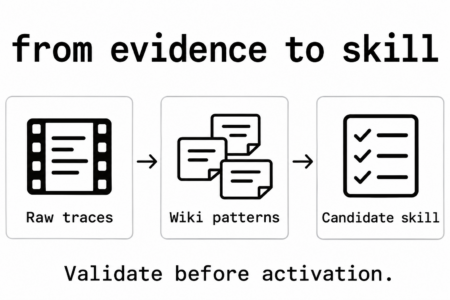
A failed run is not yet a skill
What WikiSkill gets right about turning agent experience into durable capability
TLDR: Instead of immediately patching prompts after an error, systems should adopt a layered architecture—separating raw execution traces, persistent analytical knowledge, and executable skills—to systematically compile repeated agent experiences into vetted procedures. This approach ensures that candidate skill updates are checked for regressions before activation and rolled back if they fail validation, transforming failure evidence into durable organizational capability without overloading inference context.
A well-instrumented agent run leaves evidence behind. There is the request, the context it retrieved, the tools it called, the intermediate artefacts it produced, the checks it passed and the judgement that finally accepted or rejected the result.
Saving that trace is useful. It is not learning.
The opposite shortcut is equally fragile: inspect the latest failure and immediately patch the agent's instructions. A correction that fixed one case becomes permanent procedure before anyone knows whether the same diagnosis holds elsewhere. Over time, the skill becomes a history of local reactions. Contradictory rules accumulate, old workarounds survive model upgrades, and the agent carries more instructions without becoming more dependable.
The WikiSkill paper from Google Research offers a more disciplined design. It separates raw execution history, accumulated knowledge and executable skills, then makes each layer change under a different rule.[1]
That separation is the paper's most useful contribution. The benchmark gains matter, but the architecture explains how an agent can learn from failure without treating every failure as truth.
Experience needs to be compiled
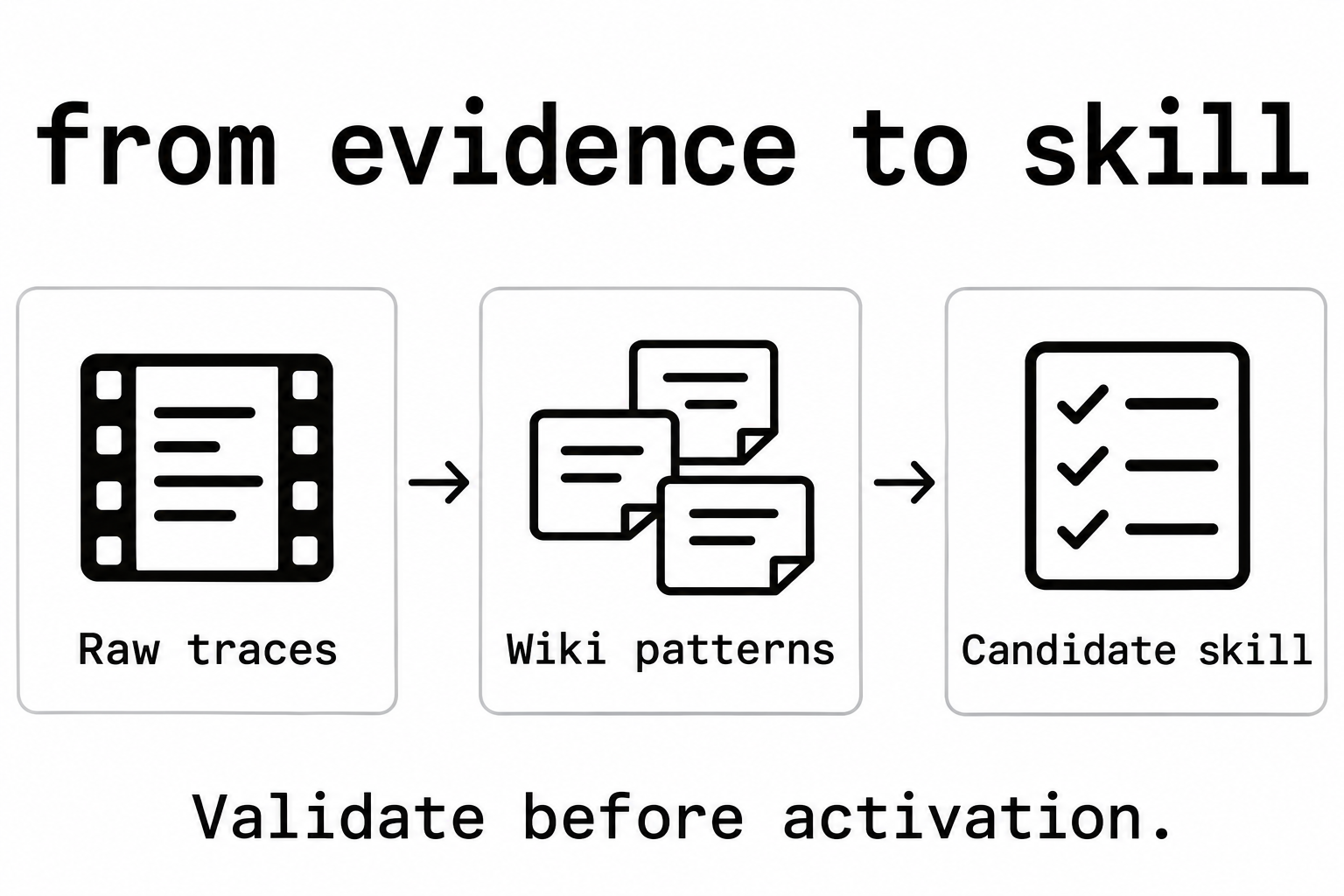
WikiSkill stores agent experience in three layers.
The Raw Layer holds immutable execution traces. These preserve the actions, observations, tool calls and outputs from each run. They are evidence, not instructions.
The Wiki Layer consolidates recurring success and failure patterns. It records root causes, practical workarounds, previous skill proposals and whether validation accepted or rejected them. This layer persists across iterations.
The Skills Layer contains the concise procedures that the task-performing agent actually follows. A skill packages instructions and supporting resources into a reusable module, a pattern also used by the Agent Skills format documented by Anthropic.[3]
The distinction matters because the three layers answer different questions:
- What happened?
- What have repeated runs taught us?
- What should the agent do next time?
Collapsing those questions creates predictable problems. A trace is too specific to be policy. A knowledge base is too broad to load into every task. A skill should be short enough to execute consistently, which means it cannot also serve as the complete historical record of how the team reached each rule.
WikiSkill acts like a compiler between these representations. A Wiki Maintainer compares successful and failed traces and updates the persistent pattern catalogue. A separate Skill Proposer reads those patterns, the history of previous interventions and selected raw traces before proposing one skill change. The system then evaluates that candidate on a validation set.[1]
If the score improves, the new skill becomes active. If it does not, the skill is rolled back. The wiki still retains the attempted change, its diff and its validation result.[1]
That asymmetry is important. A failed intervention should not keep controlling the agent, but it should keep informing the team.
The ablation isolates the knowledge layer
A memory component can improve a system for several reasons. WikiSkill tests where persistent knowledge helps.
In an ablation using Gemini-3.5-Flash across four benchmarks, a Skill Proposer without access to the persistent wiki achieved an average score of 48.7%. Giving the proposer wiki access raised the average to 63.7%, a 15-point difference.[1]
The result became worse when the task-performing inference agent could also read the wiki during training rollouts. Average performance fell from 63.7% to 60.9%.[1]
The authors' explanation is plausible. If the inference agent can solve a task directly from broad wiki knowledge, the resulting trace reveals less about whether the active skill works. The development system then has weaker evidence for improving that skill.
There is a practical lesson here. More runtime context is not always better. Accumulated experience may be more useful to the process that develops procedures than to the agent executing a specific task. Production agents need the relevant procedure and task context. Skill maintainers need the broader history of patterns, counterexamples and failed interventions.
This also changes how we should think about organisational memory. The goal is not to expose every past interaction to every future run. The goal is to compile enough evidence into the right executable behaviour while preserving the evidence needed to challenge that behaviour later.
Better skills do not make the base model irrelevant
WikiSkill reports results across five models and five benchmarks. It achieved the best average score among the compared skill-evolution methods for every evaluated model.[1]
Within the Qwen family, the improvement over the no-skill baseline grew with model size: 12.3 points for the 4B model, 17.5 for the 9B model and 23.9 for the 27B model.[1] Stronger models appeared better able to use the procedures they were given.
The reverse comparison is also instructive. Qwen-3.5-9B with WikiSkill reached 47.4% average accuracy, above the 39.4% of Qwen-3.6-27B without skills.[1]
This does not establish that small models with skills generally replace larger models. It shows that model capability and procedural knowledge are separate levers. Buying a stronger model does not automatically provide a company's operating method. Writing a better procedure does not remove the need for a model capable of following it.
That connects directly to the fine-tuning decision in the previous post. Model weights are one place to encode recurring behaviour. Skills are another. Knowledge, retrieval, controls and evaluation provide still more options. The appropriate intervention depends on the failure.
A weak base model may be unable to execute a sophisticated procedure. A strong base model may still lack a specialised workflow. Changing the model before testing the skill confounds those two problems.
Portability has to be tested
Filesystem-based skills are easy to copy. Their behaviour is not automatically portable.
WikiSkill found cases where a skill developed by one model improved another model more than that model's self-evolved skill. On ALFWorld, Qwen-3.5-9B scored 63.4% with its own evolved skill and 70.2% with a skill evolved by Qwen-3.6-27B.[1]
It also found severe negative transfer. A spreadsheet skill produced by Qwen-3.5-4B reduced Gemini-3.5-Flash from 50.5% without skills to 18.1%. The skill contained low-level workarounds and fragmented diagnostic steps that helped the smaller source model but constrained the stronger target model and consumed its interaction budget.[1]
This is a useful warning for any system that relies on portable skills across providers. A skill can encode domain procedure, quirks of the model that created it, or both. Provider optionality therefore requires regression testing, not confidence in a standard file format.
The paper also separates skill discovery from skill execution. The model best able to discover a procedure may not be the model best suited to run it. That creates useful deployment options, but only if skill provenance records the source model, evaluation set, accepted version and known compatibility limits.
Where this connects to Replai
Replai's public position is that specialised agentic workflows should encode enterprise expertise and become sharper through repeated operation.[2] In earlier posts, we described the concrete control surfaces behind that claim.
A reviewed first frame can specify what must remain visually true within a shot. A shot plan can specify what should change across a sequence. Fine-tuning becomes a candidate when a valuable failure persists across strong conditioning and workflow controls.
WikiSkill adds the next question: how should evidence from all those runs determine what changes?
Replai has implemented a separation between knowledge, skills, working context and memory. The creative workflow we have described covers concept and script development, scene decomposition, storyboards or frames, animation into animatics or GIFs, and evaluation against formal criteria. Those stages produce more than final videos. They produce a trail of intermediate decisions and failure evidence.
A practical learning loop could route that evidence as follows:
- Raw traces preserve the brief, retrieved context, generated artefacts, tool actions, evaluator outputs and reviewer decisions.
- Persistent knowledge consolidates recurring patterns, such as initial-frame defects that later cause animatic rejection, or cases where a visual fix harms gameplay fidelity.
- Skills encode the current procedure for constructing or checking a frame, decomposing a scene, planning animation or applying a taxonomy.
- Validation determines whether a candidate change improves held-out work without increasing review effort or damaging another quality dimension.
This mapping remains a proposed learning pattern. The paper provides benchmark evidence that the separation can improve skill evolution in its evaluated setup.
A useful first experiment
The smallest credible test would focus on one recurring failure class. Weak initial frames are a reasonable candidate because they have been reported as a limiting factor for later animatic quality, and because the failure connects the generation and evaluation stages.
Start with a fixed skill for producing or reviewing the initial frame. Preserve representative execution traces, intermediate frames, evaluator decisions and qualified reviewer outcomes. Build a small pattern catalogue from both accepted and rejected runs. Then propose one narrow skill change tied to specific patterns and source traces.
Evaluate the candidate on held-out briefs. The gate should include product or gameplay fidelity, taxonomy compliance, accepted-output rate, reviewer effort and cost per accepted animatic. A gain on one metric should not hide damage elsewhere.
If the candidate misses the declared gate, roll back the skill. Retain the diagnosis, diff and evaluation result. The next proposal should have to account for that failed attempt.
The experiment also needs client isolation, provenance, access control and an explicit owner for approving broad procedural changes. Creative reviewers can disagree, so validation cannot rely on an uncalibrated aggregate score. Model or provider changes should trigger compatibility tests because a procedure can depend on the executor in subtle ways.
The framework has a cost, and the paper leaves gaps
WikiSkill is an arXiv preprint evaluated on benchmarks with objective scoring. Creative acceptance is less tidy. A procedure can improve taxonomy compliance while reducing novelty, motion quality or reviewer trust.
The learning loop is also compute-intensive. Each evolution iteration requires fresh training rollouts, a Wiki Maintainer pass, roughly 10 to 20 interactive Skill Proposer turns in the reported experiments, and validation rollouts.[1] Those costs only make sense when the repeated task and expected improvement justify them.
The study injects active skills directly into the agent prompt. It does not test whether an agent retrieves or triggers the correct skill once the library becomes large. Its strict gate rejects neutral changes that might enable later improvements. The persistent wiki has no automated pruning or staleness policy. The evaluation also excludes very long tasks spanning hundreds of actions or hours.[1]
These are substantial gaps for production use. Persistent knowledge can accumulate contradictions and obsolete workarounds as readily as useful patterns. A system therefore needs lifecycle rules for ownership, client boundaries, conflict resolution, freshness and deletion. It also needs an evaluation process trustworthy enough to decide which changes become procedure.
What this post is not
This is not a claim that Replai has deployed WikiSkill or automated skill evolution. The paper does not validate Replai's implementation, data or production outcomes. It supplies a tested research mechanism that can inform a narrower experiment.
It is also not an argument that every workflow needs this machinery. A low-volume task with a capable owner may be cheaper to improve manually. Persistent skill evolution becomes worth considering when failures recur, the evaluation signal is credible and the resulting procedure will be reused often enough to recover its maintenance cost.
The durable asset is the learning record
A model can be replaced. A prompt can be rewritten. A skill can be rolled back.
The more durable asset is the evidence connecting a recurring problem to the intervention that was tried and the result it produced. WikiSkill gives that evidence a place to accumulate without forcing all of it into runtime context or active policy.
For Replai, that is the important connection. Encoding expert judgement is only the starting point. The harder problem is preserving what each execution teaches, deciding where that lesson belongs and proving that the resulting change improves future work.
A failed run is useful when it changes the next decision. It becomes organisational capability when the path from evidence to procedure remains inspectable, testable and reversible.