


When should you fine-tune a video model?
A decision framework for knowing when inference-time control is no longer enough
TLDR: Fine-tuning should only be considered when a persistent, measurable failure recurs across many shots and survives best-in-class inference conditioning, references, and shot planning. Because updating video models frequently creates hidden trade-offs—such as suppressing dynamics, leaking appearance into motion, or degrading base capabilities—teams should favor the smallest adequate intervention (like lightweight adapters) evaluated strictly against production economics and regression baselines.
Fine-tuning is an attractive answer to a frustrating generation problem. The model keeps changing a product. It ignores a camera move. It produces the right action with the wrong visual language. A small custom dataset and a training run seem like a direct route to control.
Sometimes they are. Often they turn a visible failure into a less visible one.
A tuned model can reproduce the target style while losing prompt responsiveness. It can retain a subject while suppressing motion. It can learn the movement in a reference video together with the actor, background and camera that happened to demonstrate it. The output looks more specialised, but the system has become narrower and harder to diagnose.
The useful question is therefore not “Can we fine-tune this model?” Open video models and training frameworks increasingly make that possible. The useful question is: what evidence would justify changing the model rather than changing the inputs, controls or workflow around it?
This is the third step in a sequence. A strong opening frame can specify what should remain visually true. A shot plan can specify what should happen over time and across clips. Fine-tuning becomes relevant when the same important failure survives both kinds of control.
Fine-tuning changes the prior
Prompting, reference images, trajectories and keyframes condition one generation. Fine-tuning changes the model’s parameters, and therefore changes what the model tends to generate across many requests.
That distinction gives us the first decision boundary.
If the requirement changes from shot to shot, it probably belongs in conditioning or planning. The position of a product, the action in a scene, a specific transition and the end state of a shot are instance-level requirements.
If the requirement recurs across many shots and is poorly represented by the base model, adaptation becomes more plausible. Examples might include a distinctive animation language, a recurring class of non-human product motion, a specialised camera grammar or a domain whose objects the model repeatedly renders incorrectly.
Even then, recurrence is not enough. The failure must be stable, measurable and valuable to fix. “The outputs do not feel right” is not a training objective. “The model changes these three product features in 38% of otherwise acceptable shots” could become one, once the taxonomy and measurement are reliable.
Start with the no-training baseline
Before collecting training data, establish the strongest workflow that does not modify the model.
For a representative set of prompts, compare:
- text prompting only;
- a reviewed first frame;
- additional subject or product references;
- explicit camera, trajectory or pose control where the model supports it;
- shot decomposition with start and end anchors;
- retrieval of known-good prompt, reference and parameter combinations.
Hold the model version, seed budget, resolution and number of attempts constant. Evaluate accepted-output rate, retries, review time and cost per accepted clip rather than visual appeal alone.
This baseline matters for two reasons. First, it can solve the problem more cheaply. Second, it identifies the residual that training must address. Without it, a fine-tuned model is being compared with an intentionally weak alternative.
A model update should have to beat this baseline on held-out cases. It should also retain the base model’s useful capabilities. Otherwise, the team may be paying training and maintenance costs to move a control that could have remained outside the model.
“Fine-tuning” covers several different interventions
The smallest adequate update is usually the right first experiment.
1. A lightweight concept or style adapter
Low-Rank Adaptation, or LoRA, freezes the base weights and learns a low-rank update for selected layers. The resulting adapter is much smaller than a complete model checkpoint and can often be loaded, removed or versioned separately.[1]
For video, LoRAs and related adapters can target different concepts. DreamVideo, for example, separates subject learning from motion learning using distinct lightweight components.[2] VideoMage similarly uses subject and motion LoRAs, but adds explicit mechanisms to stop a motion adapter from absorbing the appearance of the reference video.[3]
This makes a LoRA a reasonable first test for a narrow, repeated concept. It does not make it a universal solution. Adapter placement, the training objective and the examples determine whether the model learns the intended concept or a shortcut correlated with it.
2. A control adapter
Sometimes the missing capability is not a new style or subject. It is a new input channel.
If every generation should obey depth, pose, edges, segmentation or another structured signal, a paired control adapter can be more appropriate than teaching the model to infer that signal from text. Lightricks’ public LTX-Video training tools distinguish standard LoRA training from in-context LoRA training, where paired reference and target videos teach transformations such as depth-to-video, pose control or restoration.[6]
This changes the interface to the model. It is justified when the control signal is available reliably at inference time and when its added precision outweighs data preparation, latency and integration cost.
3. Supervised fine-tuning
Supervised fine-tuning updates the model toward a curated distribution of video-caption pairs. It can be parameter-efficient or update the full model.
A broader update offers more capacity, but also more ways to damage existing behavior. Public LTX tooling describes full fine-tuning as the option for major adaptations when LoRA is insufficient, with substantially greater memory, dataset and checkpoint requirements.[6] That is a useful ordering principle, not evidence that full fine-tuning will improve a particular product.
4. Preference or reward-based post-training
Some requirements are easier to express as comparisons than target videos. Reviewers may agree that one output preserves the product better, follows the brief more closely or contains less temporal flicker, even when there is no single correct video.
VideoDPO adapts direct preference optimisation to video by constructing preferred and rejected pairs from measures of visual quality and semantic alignment.[7] PersonalVideo uses identity and semantic rewards on generated videos to improve identity fidelity while trying to preserve motion and prompt following.[4]
These methods are relevant when the feedback signal actually represents the production objective. They are dangerous when it does not. A judge that rewards polished frames but misses incorrect gameplay, implausible motion or a changed product can train the model to become better at the wrong target.
Video fine-tuning has video-specific failure modes
Image adaptation intuition does not transfer cleanly to video.
Appearance can leak into motion
A reference video never contains “motion” alone. It contains a subject, background, viewpoint, lighting and camera behavior. A naive motion adapter can learn these correlations together. VideoMage reports this appearance-leakage problem and introduces an appearance-agnostic objective to separate them.[3]
The practical test is compositional: can the learned motion be applied to unseen subjects, scenes and viewpoints? Reconstructing the training clips is weak evidence.
Identity training can suppress dynamics
Training on a few static identity images can shift a video model away from its temporal prior. PersonalVideo describes this as a tuning-inference gap: optimisation on static-image reconstruction can produce videos that are more static and less responsive to prompts.[4]
A recent subject-driven video preprint reports a related result. Naive image-only fine-tuning degraded temporal coherence, so the authors alternated identity learning from image pairs with motion-preservation updates from arbitrary videos.[5] The reported recipe is research evidence, not a transferable cost estimate, but the principle is important: improving one dimension can erase another.
Multiple adapters can interfere
A subject adapter, style adapter and motion adapter do not automatically compose. Their updates can compete for the same layers or dominate at different denoising stages. A successful isolated LoRA therefore does not prove that the production stack will work once several controls are active.
Test the intended combinations, including strength ranges and order of application. Keep each adapter independently removable until composition has been evaluated.
The dataset teaches its accidents
A small dataset has a large editorial voice. Repeated backgrounds, shot lengths, camera directions, actor types, watermarks or caption omissions can become part of the learned behavior.
Video-data curation work commonly filters scene cuts, overlays, low-motion clips, temporal discontinuities and weak captions before training.[8] For a specialised adaptation, generic quality filtering is only the start. The dataset also needs deliberate variation in every factor that should not be learned.
If a motion should generalise across products, vary the products. If a style should survive different cameras, vary the cameras. If geometry must remain exact, include adversarial views that expose it. Record the licence, consent, provenance and permitted use of every training asset. A technically effective model trained on unusable data is not an asset.
The evaluation must look for what was traded away
A fine-tuning evaluation needs three sets:
- Target set: representative cases containing the failure the adaptation should fix.
- Composition set: unseen combinations of subjects, motions, settings and controls.
- Regression set: cases the base model already handles well.
Use the same inference budget for the base and adapted models. Compare at least:
- subject or product fidelity;
- motion adherence and dynamic degree;
- prompt and shot-specification adherence;
- temporal consistency and artifact rate;
- diversity across seeds;
- compatibility with references and other controls;
- accepted-output rate;
- review time and cost per accepted output.
Do not select the checkpoint on the target metric alone. Select it against a declared trade-off envelope. For example: improve product-feature retention by a specified amount without reducing motion acceptance, prompt adherence or base-domain acceptance beyond agreed limits.
Blind review is preferable where possible. Keep the frozen base model in every evaluation cycle. Provider or base-model upgrades must trigger regression tests because an adapter is coupled to the architecture and checkpoint on which it was trained.
A practical investment sequence
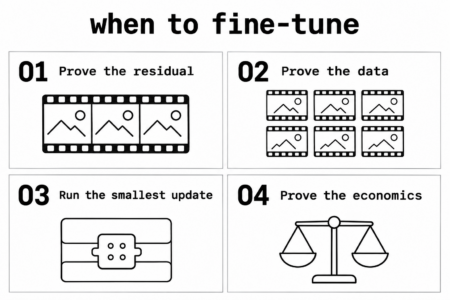
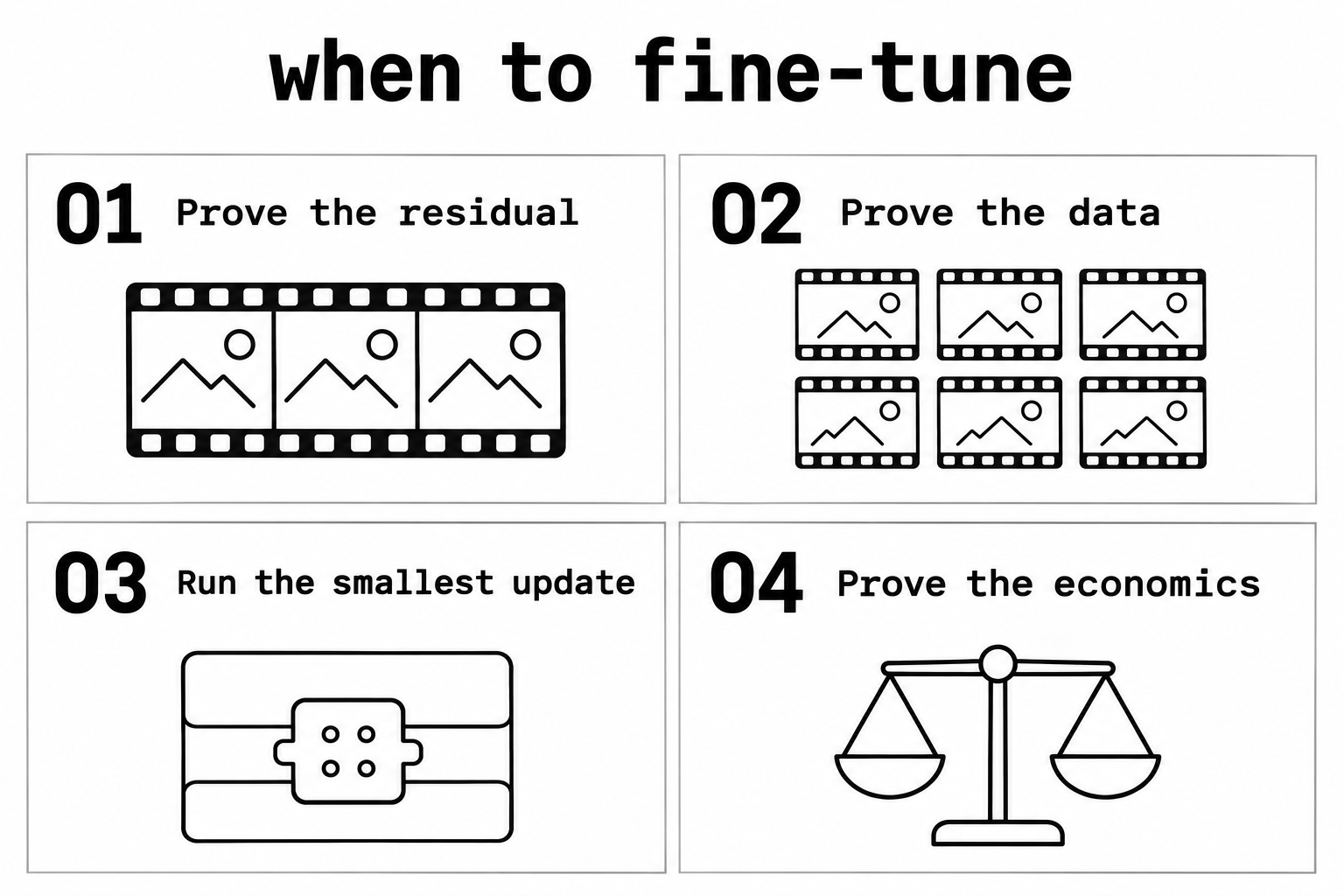
A team considering video-model adaptation can use four gates.
Gate 1: prove the residual. Show that a repeated, commercially meaningful failure remains after strong prompting, reference conditioning, controls and shot planning.
Gate 2: prove the data. Demonstrate that representative, legally usable examples exist, including counterexamples and variation in factors that should generalise.
Gate 3: run the smallest update. Start with a targeted LoRA or control adapter. Compare it with the frozen model under a matched inference budget. Include composition and regression tests from the first run.
Gate 4: prove the economics. Measure accepted outputs, reviewer effort, training and hosting cost, adapter maintenance and the impact of base-model upgrades. Move to broader supervised or preference post-training only if the lightweight intervention leaves a valuable residual.
The experiment should be easy to stop. A tuned model that cannot clear the regression and economic gates should remain a research artifact.
Fine-tuning is a claim about recurrence
The first-frame contract says what must remain true inside a shot. The shot plan says what must remain true or change across a sequence. Fine-tuning says something stronger: this requirement recurs often enough that the model’s default behavior should change.
That claim should carry a higher evidence burden.
The emerging tooling makes model adaptation increasingly accessible. The hard part is no longer launching a LoRA training job. It is deciding what the model should learn, constructing data that isolates that behavior, detecting what the update erased and proving that the adapted system improves production economics rather than a convenient benchmark.
Until those conditions hold, better conditioning and orchestration preserve more optionality. When they do hold, fine-tuning can turn a recurring workaround into a reusable capability.
Sources
- Hu et al., “LoRA: Low-Rank Adaptation of Large Language Models,” 2021.
- Wei et al., “DreamVideo: Composing Your Dream Videos with Customized Subject and Motion,” CVPR 2024.
- Huang et al., “VideoMage: Multi-Subject and Motion Customization of Text-to-Video Diffusion Models,” CVPR 2025.
- Li et al., “PersonalVideo: High ID-Fidelity Video Customization without Dynamic and Semantic Degradation,” ICCV 2025.
- Kim et al., “Learning Zero-Shot Subject-Driven Video Generation Using 1% Compute,” arXiv preprint, 2026.
- Lightricks, “LTX-Video Trainer: Training Modes Guide,” official documentation.
- Liu et al., “VideoDPO: Omni-Preference Alignment for Video Diffusion Generation,” arXiv preprint, 2024.
- Xianpan Zhou, “Tiger200K: Manually Curated High Visual Quality Video Dataset from UGC Platform,” arXiv preprint, 2025.